

This summer, for the first time in the sport’s history, the FIFA World Cup will be held across three nations simultaneously. When Mexico kicks off against South Africa at the Estadio Azteca in Mexico City on 11 June 2026, it will mark not just the beginning of a tournament but the opening of a 38-day continental celebration that will sweep from Vancouver in the north to Mexico City in the south, from Boston in the east to Los Angeles in the west before concluding with the final at MetLife Stadium in New Jersey on 19 July.
The 2026 FIFA World Cup is the first tournament to feature 48 national teams, the first to be hosted by three countries, and with 104 matches played across 16 cities, the largest World Cup ever staged in terms of scale, participation, and geographic coverage. It is, by almost any measure, the most ambitious sporting event ever organised.
A Tournament of Firsts
The scale alone is remarkable. An expanded field of 48 teams in 12 groups of four will play 104 matches, with the top two teams in each group and the eight best third-placed teams advancing to a new round of 32, adding an entire additional knockout round compared to previous editions.
The United States will host 78 matches, including all fixtures from the quarterfinals onward, while Canada and Mexico will each host 13. AT&T Stadium in Arlington, Texas, will host the most matches of any venue in the tournament, with nine. The three host nations are divided into geographic clusters to minimize travel, with a western group anchored by Los Angeles, Vancouver, and Seattle; a central group spanning Dallas, Houston, Kansas City, and the three Mexican cities; and an eastern corridor running from Toronto and Boston down through New York, Philadelphia, and Miami.
Mexico City is the only capital city of the three host nations to be chosen as a venue, and Mexico will become the first country to have hosted FIFA World Cup matches across three separate tournaments – 1970, 1986, and now 2026. The Estadio Azteca, scene of Pelé’s brilliance in 1970 and Maradona’s hand of God in 1986, hosting an opening match once more is a piece of footballing poetry that needs no embellishment.
The Significance for the Host Nations
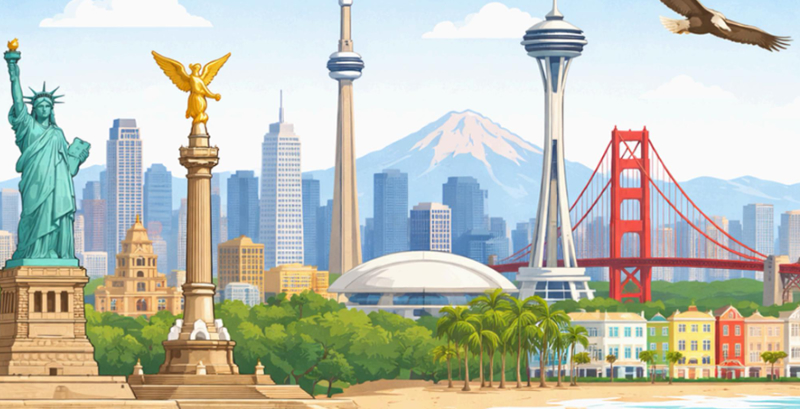
For Mexico, the World Cup is a homecoming. Football is woven into the national identity — Liga MX boasts some of the largest attendances in North America, and the passion for the sport is widespread and deeply embedded in culture. Hosting matches in Mexico City, Guadalajara, and Monterrey will be less a novelty than a celebration of something already deeply known and loved.
For Canada, the significance is of a different kind. Interest in football saw a notable 32.8% increase following the announcement of Canada co-hosting the tournament, and the men’s national team’s qualification for the 2022 World Cup – their first in 36 years – further boosted enthusiasm, with 35.6% of Canadians reporting increased interest in watching the sport afterward. The 2026 tournament represents a genuine watershed moment for a country where the game has long sat in the shadow of ice hockey, and where a generation of talented young players is now beginning to emerge.
The United States is perhaps the most interesting case. For decades, soccer has battled for attention in a crowded sports landscape dominated by American football, basketball, and baseball. The 2026 World Cup is expected to catapult the sport into the mainstream consciousness in ways previously unimaginable. The precedent is instructive: when the United States first hosted the World Cup in 1994, the tournament led directly to the establishment of Major League Soccer, which now boasts 29 teams. The question of what 2026 might catalyse in a country where soccer’s demographic and cultural soil has matured considerably since then is one of the more intriguing long-term questions the tournament poses.
Adding a particular resonance to the American hosting, the 2026 World Cup falls during the year the United States celebrates its 250th anniversary. Philadelphia – one of the host cities and the birthplace of American independence – is scheduled to host a World Cup match on 4 July itself, the 250th anniversary of the nation’s founding.
The Cities and the Spectacle
The 16 host cities collectively constitute a portrait of North American civilization in its remarkable diversity. New York, hosting the final, brings its unmatched cosmopolitan energy and its vast immigrant communities for whom football is not a spectacle but a mother tongue. Los Angeles, Miami, and Houston – three of the most Latino cities in the United States – will generate an atmosphere closer to Buenos Aires or São Paulo than to anything typically associated with American sport.
Lesser-known US host cities are also preparing for their moment. Kansas City, for instance, expects 650,000 visitors, with Argentine superstar Lionel Messi’s team scheduled to play an early group stage match there. For cities unaccustomed to being on the global sporting map, the exposure alone carries a significance that outlasts the tournament.
The fan experience across three countries will itself be part of the story. Traveling supporters will be able to move between the rich urban culture of New York, the ancient traditions of Guadalajara, and the vibrant multiculturalism of Toronto – sampling tacos, poutine, and barbecue, experiencing the distinct sporting atmospheres of each nation. No previous World Cup has offered its visitors anything quite like this geographical and cultural range within a single tournament.