
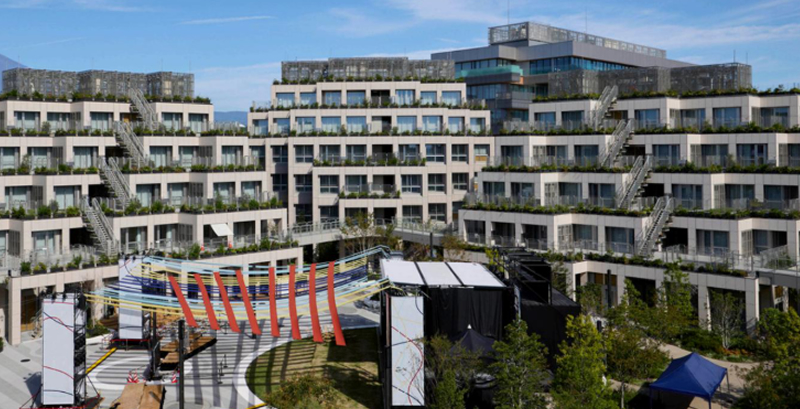
In September 2025, something quietly remarkable happened at the base of Mount Fuji. Toyota opened a city. Not a technology park, not a research campus — a city, with residents, streets, homes, energy infrastructure, and a design philosophy rooted in human wellbeing.
Woven City describes itself as a test course for mobility, driven by a collaborative community with a shared passion to enhance well-being for all; a place to co-create, test, and bring to life products and services addressing everyday societal challenges around the movement of people, goods, information, and energy.
The project began as personal conviction rather than corporate strategy. Eight years ago, Toyota chairman Akio Toyoda unveiled his vision for a “prototype city” following the closure of the Toyota Higashi-Fuji Plant — and now, carrying forward the plant’s history and supported by partners well beyond the automotive industry, the city-sized test course is operational.
The 71-hectare urban laboratory completely segregates mobility into three distinct road types — one for autonomous vehicles, one for cyclists, and one for pedestrians — eliminating traditional car traffic and prioritising human-centred movement. Its zero-carbon energy ambition is underpinned by hydrogen fuel-cell energy and solar power, with an initial population of 360 residents providing real-time data for AI-driven urban management.
The project has already received LEED for Communities Platinum certification, the first such designation in Japan, and the city is planned to grow to approximately 2,000 residents.
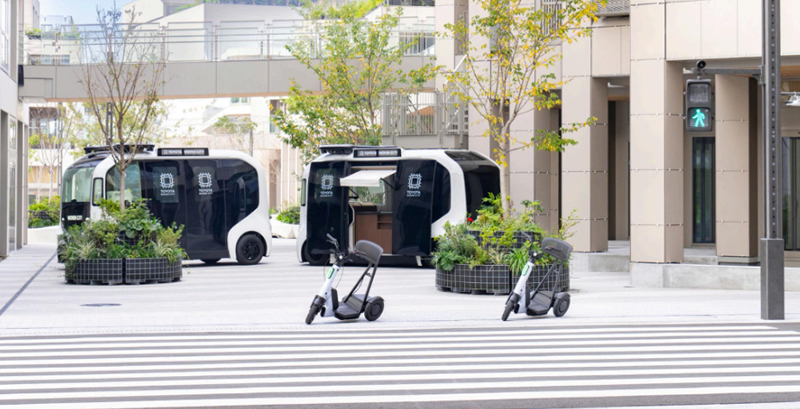
The community of partners assembled around it is striking in its breadth. The ‘inventors’ are companies developing and testing their products and services within the city, and includes Daikin Industries, Nissin Food Products, DyDo DRINCO, Interstellar Technologies, Denso, and Aisin, supported by energy group ENEOS, telecoms giant NTT, and others.
This is not a Toyota branding exercise. It is a cross-sector consortium using a working city as shared research infrastructure. The guiding philosophy is Kakezan — a Japanese concept of multiplication. The city is also not without cultural continuity: it features a reproduction of the wooden hand loom invented by Toyota founder Sakichi Toyoda in 1890 which was built, as company history records, to ease his mother’s burden of weaving cloth through the night. The founding ethos of making life easier for others runs as a thread through the entire project.
Toyota has established Toyota Invention Partners with approximately $670 million in capital focused on accelerating collaborations between Toyota, Woven by Toyota, and external partners. Its venture arm, Woven Capital, has simultaneously launched a second fund of $800 million, targeting 20 to 25 new investments in AI, automation, climate technology, energy, and sustainability. This is venture capital deployed at industrial scale, into the precise intersection of themes that define the growth frontiers of the coming decades.
For patient, long-horizon investors, Woven City is interesting less as a Toyota story and more as a directional signal across several converging themes. The most immediate is the maturation of the smart city concept from aspiration to operation. Projects of this ambition have historically struggled to move from planning documents to lived reality. Unlike earlier smart city experiments such as Masdar or Songdo, Woven City is designed as a genuine living laboratory, with residents, real logistics needs, and real health and behavioural data — positioning it to lead in mobility markets some analysts project at $1 trillion. A credible operational proof of concept at this scale raises the investment case for the entire smart infrastructure sector.
The second signal concerns hydrogen. The clean energy debate has at times presented battery-electric as the settled answer. Toyota’s decision to make hydrogen fuel-cell infrastructure central to a decade-long urban experiment — backed by ENEOS and with LEED Platinum recognition — suggests the question remains more open than the prevailing narrative implies. Investors who have written hydrogen off entirely may wish to revisit that position.
The third, and perhaps most underappreciated, implication is about data. AI trained on the behaviour of real people in real homes, navigating real streets, is qualitatively different from AI trained in simulated environments. The residents of Woven City are, among other things, the data source for systems that, if proven, could be adapted for cities worldwide. The value of that data, over time, may substantially exceed the value of any individual product tested within the city’s streets.
Woven City may remain a compelling but contained experiment. Or it may prove to be a prototype for how the built environment of the mid-21st century is designed, powered, and managed.