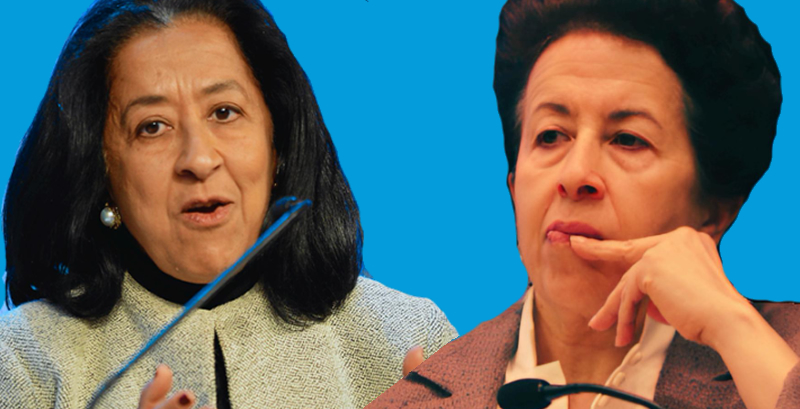
An introduction to Lubna and Hutham Olayan, the quietly formidable forces behind one of the world’s most consequential private investment empires.
At Saudi Arabia’s Future Investment Initiative conference this year — known as Davos in the Desert — Lubna Olayan hosted a gathering in Riyadh attended by some of the world’s most senior financial executives. It was a characteristically understated display of influence from a woman who has spent decades at the intersection of Saudi Arabia and global capital without ever courting the attention that intersection commands. That her sister Hutham was elsewhere, overseeing the New York operations of the same empire, was equally typical. Between them, the Olayan sisters have spent four decades building one of the world’s most consequential private fortunes while avoiding, almost as a matter of principle, the spotlight that usually accompanies such achievement.
A Dynasty Built from Nothing
The story of the Olayan Group begins, as the best stories do, with almost nothing. Suliman Olayan was orphaned at a young age, learned English, and spent years working as a transportation dispatcher at the predecessor company of Saudi Aramco. He mortgaged his house for $8,000 to win a pipeline contract. From that beginning, in 1947, he built what would become one of the most significant private business empires in the Arab world.
The Olayan Group is a multinational enterprise with international offices in New York, London, Luxembourg, Athens, Riyadh, and Singapore, investing across public and private equities, real estate, and fixed income securities, with a portfolio concentrated in North America, Europe, Asia, and the Middle East. Today it operates at a scale that invites comparison not with other family offices but with sovereign wealth funds.
Suliman’s daughters — Hutham, Hayat, and Lubna — grew up in a household where commerce was the native language. Lubna grew up in cosmopolitan Beirut, the youngest of the siblings. Suliman was a stern but invested father who closely tracked his daughters’ academic performance. Lubna spent nine years in the United States, studying at Cornell University and then at Indiana University, where, alongside her sister Hutham, she earned an MBA.
Two Sisters, One Empire

The division of responsibility that emerged between the sisters has the elegance of a well-designed institution. Lubna led the Middle East-focused division and Hutham took charge of Olayan America. That structure has held, and deepened, for four decades.
Lubna, as CEO of Olayan Financing Company, oversees the group’s operations across Saudi Arabia and the wider Middle East — a portfolio that includes partnerships with more than 40 international companies including Coca-Cola, Nestlé, Colgate-Palmolive, and Kimberly-Clark. Hutham, as CEO and president of the group’s US-based investment arm, manages one of the most quietly powerful pools of capital in American finance. According to Bloomberg’s reporting in December 2025, the group’s US equity portfolio stood at approximately $12.7 billion, including stakes of close to $1 billion in BlackRock and $1.5 billion in JPMorgan Chase, alongside positions in Microsoft, Alphabet, and Amazon. These figures reflect market valuations at that point in time and will fluctuate with markets.
The group’s private equity portfolio is estimated to run into the tens of billions of dollars. The Olayan Group states on its own website that the compounded annual growth rate for its direct investments has exceeded 30% over a ten-year period — an exceptional figure by any institutional benchmark, though one drawn from the group’s own published materials. Real estate holdings, according to Bloomberg’s December 2025 analysis, span more than 40 million square feet and approximately 40,000 managed apartments globally. The group’s total assets under stewardship are broadly estimated at over $50 billion, though as a private concern the Olayans do not publish consolidated figures.
Hutham sits on the board of Brookfield Asset Management — one of the world’s largest alternative asset managers — and the sisters have also acquired a stake in the ICD Brookfield tower in Dubai. Lubna, meanwhile, has close connections to BlackRock co-founder Larry Fink, among others, and was recently named co-chair of the US-Saudi Business Council alongside Citi’s Jane Fraser.
Pioneers in a Country Changing Around Them
To understand what the Olayan sisters have built, it is necessary to understand the environment in which they built it. The duo came of age at a time when women were not permitted to drive and needed a male guardian’s permission even to get a passport in the kingdom. That they did not merely succeed within this environment, but helped transform it, is perhaps their most significant achievement.
Lubna was the first woman elected to the board of a public company in Saudi Arabia, in 2004. In 2018, she became the first woman to chair a Saudi bank. Until 2001, she was the only woman working for the Olayan Financing Company conglomerate. Today there are more than 400, across 28 of its 30 companies. She built internal programmes — OnWARD and the Olayan Women’s Network — that identified, trained, and placed Saudi women in professional roles across the group’s operations, treating inclusion not as a symbolic gesture but as an operating system.
Hutham articulated the family’s philosophy in a speech before the Arab Bankers Association of North America in 2013: “We generally do not seek the spotlight, and we avoid ostentatious displays, leaning towards austerity.” It is a philosophy the sisters have adhered to with almost stubborn consistency, even as their influence has grown to the point where global financial executives compete for their attention.
The Bridge Builders
The Olayan Group’s significance has only grown as Saudi Arabia’s Vision 2030 programme has deepened the kingdom’s engagement with global capital markets. Key to the sisters’ growing profile are their relationships on Wall Street and within the kingdom, particularly as Riyadh has started to intensify pressure on foreign firms to invest more locally and help diversify the economy.
When Western financial institutions seek intelligence on navigating the Saudi economy, or entrée to its most significant relationships, the Olayans are frequently the first call. Senior officials on Wall Street regularly turn to the family for advice amid their efforts to expand into an economy reshaped by Crown Prince Mohammed bin Salman.
The journey has not been without setbacks. The group was among the major investors in Credit Suisse, holding on as the bank declined and sustaining significant losses when UBS took it over. Despite the magnitude of those losses, the group dealt with them as relatively normal, and financial operations continued without disruption.
Lubna and Hutham Olayan are, in the most precise sense, bridge builders: between a kingdom reshaping itself and a financial world eager to participate in that reshaping, between the generation that built the empire and the one that will inherit it, and between the Saudi Arabia of their childhood and the one their work has helped, quietly and durably, to create.