
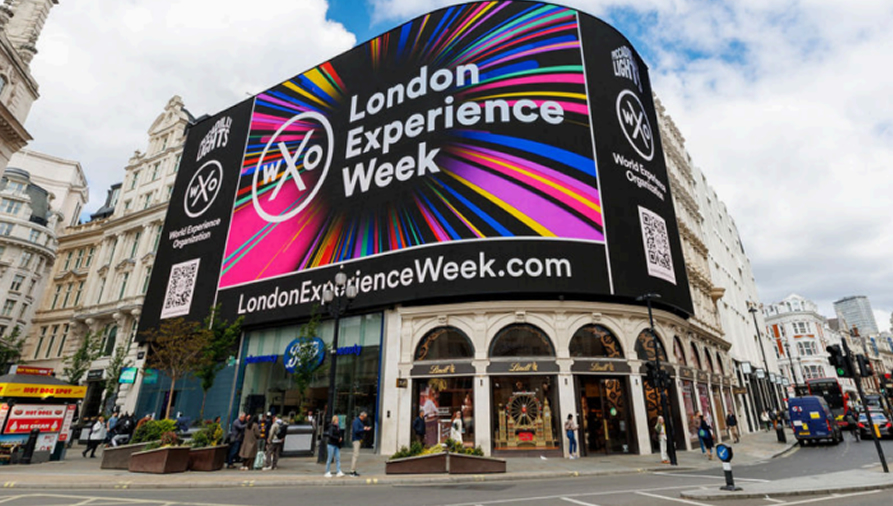
For five days in April, London became the undisputed capital of the global experience economy. The second edition of London Experience Week, hosted by the World Experience Organisation (WXO) in partnership with London & Partners, drew around 750 senior leaders, creators, and operators from more than 40 countries to a city-wide programme of talks, behind-the-scenes tours, industry awards, and immersive encounters. Its flagship World Experience Summit, a curated Experience Safari, and an expanding lineup of fringe events and activations spread across the capital made it one of the most ambitious gatherings the sector has yet seen.
At its heart was a simple but powerful idea: that the people designing and delivering the world’s most compelling experiences from immersive theatre to experiential retail, transformational travel to location-based entertainment, deserved a dedicated home.
The World Experience Organization was founded in 2020, with co-founders from Helsinki to Melbourne, from Shanghai to San Francisco, as a global institution dedicated to improving the quality of experiences, enhancing the opportunities for experience creators, and promoting the Experience Economy. Its founder and CEO, James Wallman, built the WXO on the conviction – first articulated by business theorists Joe Pine and Jim Gilmore in their 1999 book The Experience Economy – that the world was shifting from an economy that manufactures things to one that makes memories, and that the people driving that shift deserved an institution of their own.
‘Think of us as the World Economic Forum, but for experiences’, was how Wallman described it. The WXO grew steadily from that founding vision, and by 2026 had become a leading expert on the $13 trillion Experience Economy, uniting top professionals from entertainment, hospitality, tourism, and other sectors to shape the future of experiences, with more than 1,100 members from over 50 countries.
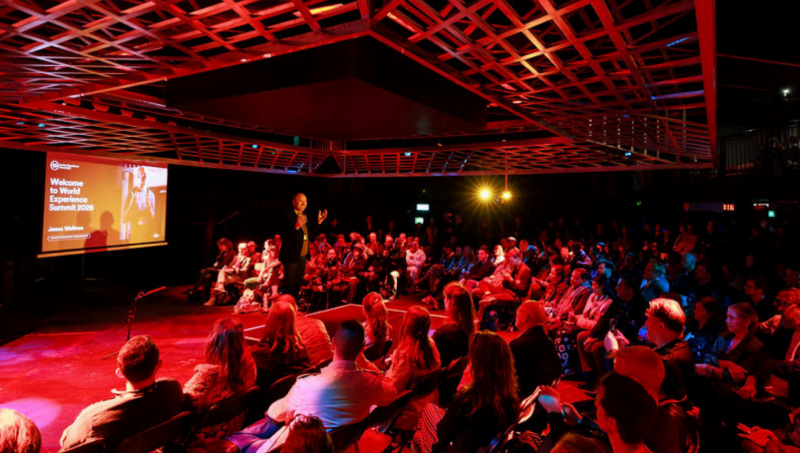
London Experience Week 2026 ran from 20 to 24 April, anchored at Ministry of Sound for the World Experience Summit, with the Experience Safari taking participants out across the city. Now in its fourth year, the programme has expanded steadily, with previous editions selling out and participation increasing year on year.
The Summit itself was the intellectual engine of the week – a multi-day programme of talks, case studies, and workshops featuring voices from across the experience landscape. There was a keynote address by the Deputy Mayor of London for Business & Growth, alongside speakers from Odyssey Works, Innovate UK, Secret Cinema, Third Rail Projects, SCAD, Royal Holloway University, and many more. The format was notable for what it refused to be: a passive broadcast of presentations. An unconference format and a no-phones ‘Dark Room’ running under Chatham House rules created space for honest, off-the-record conversations that rarely happen at more conventional industry gatherings.
The Experience Safari extended the week far beyond the summit venue. Confirmed events included an exclusive opening night at Lightroom for David Bowie: You’re Not Alone, a private listening room experience from L-Acoustics, and an inside look at the transformative world of Bompas & Parr, alongside behind-the-scenes tours of Vikings: The Immersive Experience and Punchdrunk’s Lander 23. Attendees also had access to exclusive visits and activations at venues including ABBA Voyage, Outernet, Olympia, The Crystal Maze Experience, Pixel Artworks’ London studio, and a special launch activation at Piccadilly Lights.
As one attendee from a previous edition put it: “The most rewarding experience we had this year was at London Experience Week. And this is after having been to other events like SXSW and Cannes Lions.”
The crowd at London Experience Week was unlike that at almost any other industry event. It brought together a ‘United Nations’ of experience creators, from immersive entertainment to experiential marketing and AI-driven retail – directors and founders, creative directors and technologists, academics and investors, all united by a professional preoccupation with what it means to design something someone will remember.
The networking was tangible and productive. Samit Garg of E-Factor in India and Ludovica Arci of SARAVA in Italy got talking at London Experience Week 2025 – a conversation that turned into a real project. Sergio Ramirez of Demiurgo in Mexico met Florian Woegerer of boraborastudios in Spain and Alex Wills of Disguise in the UK. “The people we met at LXW quickly became collaborators,” Ramirez noted. Sharon Reus, CEO of CPG Agency in the US, found the WXO community had become a genuine talent pipeline for her agency. “I’ve hired great people through the WXO,” she said.
The emphasis on practical knowledge was a defining characteristic – sessions structured to move beyond high-level discussion and offer applied insights drawn from real-world projects, reflecting a shift in the industry where attendees increasingly expect actionable frameworks rather than purely conceptual presentations.
What made London Experience Week more than a conference was the community that sustained it the other fifty-one weeks of the year. The WXO is the global community for professionals working in the experience economy – from immersive entertainment to transformational travel – with members in over 50 countries. Through curated content, monthly Campfires, and events such as London Experience Week, the WXO connects and supports those who design the future of experiences.
The Campfire sessions are the WXO’s most distinctive ongoing offering. The WXO has run more than 150 weekly virtual Campfires to champion and challenge the pioneers at the forefront of the experience revolution, many of which are available to view on-demand. These informal, expert-led conversations – covering everything from experience design frameworks and the neuroscience of awe to the economics of transformation – have featured contributors from Walt Disney Imagineering, Meow Wolf, Secret Cinema, and beyond. Todd Richins, Executive Producer and VP at Walt Disney Imagineering, described a Campfire as “so inclusive and engaging, I was actually taking notes.”
Members also have access to the World Experience Circle, a private platform open 24/7 where community members share news, new experiences and work opportunities, ask questions, and organise meetups in cities from Amsterdam to New York. The World Experience Circle has been awarded Platinum Community status by the tech platform it is built on – among the top 10% of 8,500 communities for engagement. Membership tiers run from student and emerging talent through to individual, professional, and organisational levels, with full members invited to every weekly live Campfire, giving them access to the global conversation, tools, and connections that drive the Experience Economy.
London Experience Week is the world’s first city-wide festival dedicated to the Experience Economy, an industry worth £134 billion in the UK alone. The choice of London as its home was not merely geographic. The city offered a uniquely concentrated ecosystem: its strengths in culture, creativity, technology, and hospitality make it a global testing ground for new experience formats – a place where immersive theatre, world-class museums, cutting-edge technology studios, and some of the world’s most visited attractions exist in productive proximity.
As James Wallman put it: “London Experience Week has become the moment when the global experience economy converges on London”. In April 2026, that convergence was more complete, more international, and more creatively charged than ever before. For those who were there, it was less a conference than a proof of concept – evidence that the experience economy had found its annual home, and that London was exactly the right place for it.