
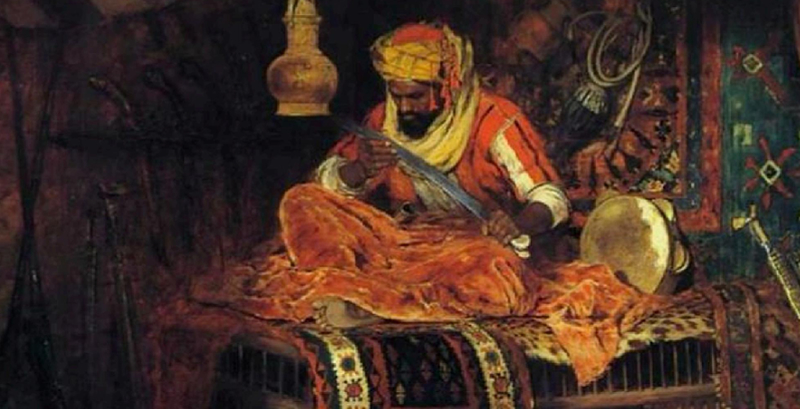
The ninth-century polymath who shaped the way the Western world eats, dresses, and listens to music.
History has its celebrated polymaths; figures whose curiosity and talent ranged so far beyond a single discipline that their influence becomes difficult to contain within any one field. Leonardo da Vinci is the name most readily reached for. But more than six centuries before Leonardo, a man born in what is now Iraq arrived at the Umayyad court of Córdoba and quietly proceeded to transform the cultural life of medieval Europe in ways that still echo, largely unacknowledged, in the rhythms of daily life today. His name was Abu al-Hasan ‘Ali Ibn Nafi’. History knows him as Ziryab, the Blackbird.
The Making of a Legend
Ziryab was born around 789 CE, most likely in Baghdad, then the intellectual and cultural capital of the Islamic world. He was trained in music from a young age by the celebrated musician Ibrahim al-Mawsili, in a city that was at that time an important centre of music in the Muslim world.
The story of how he came to leave Baghdad has the quality of legend. One account recorded by the historian al-Maqqari says that Ziryab inspired the jealousy of his own mentor by giving an impression performance for the caliph Harun al-Rashid – with the result that al-Mawsili told him to leave the city. Whether or not this account is entirely accurate, it captures something true about the nature of exceptional talent: it tends to outgrow its origins.
From Baghdad, Ziryab travelled first to Syria, then to Kairouan in what is now Tunisia, before receiving an invitation that would define the rest of his life. In 822 CE he was invited to Al-Andalus by the Umayyad prince Al-Hakam I. Arriving to find the prince had died, he was welcomed instead by the prince’s son, Abd ar-Rahman II, who renewed his father’s invitation. Ziryab settled in Córdoba with a monthly salary of 200 gold dinars – a figure that speaks to how highly his gifts were valued.
It was here, in the glittering court of one of medieval Europe’s most sophisticated cities, that Ziryab flourished.
The Music
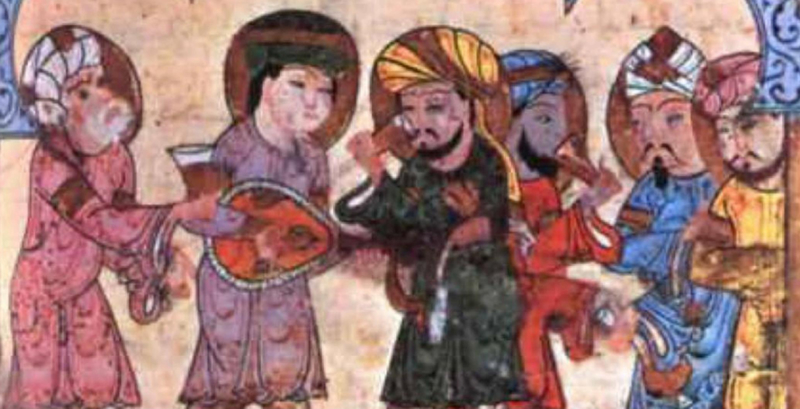
Music was the foundation of everything. Ziryab is said to have created a unique and influential style of musical performance and written songs that were performed in Iberia for generations. He was a great influence on Spanish music and is considered the founder of the Andalusian classical music traditions of North Africa.
He was also an innovator of the instrument itself. Ziryab improved the oud by adding a fifth pair of strings, and used an eagle’s beak or quill instead of a wooden pick. He dyed the four original strings colours to symbolise the Aristotelian humours, and dedicated the fifth string to representing the soul.
His greatest institutional legacy was the school he established. He founded one of the first schools of music in Córdoba, incorporating both male and female students, who were very popular amongst the aristocracy of the time. The school influenced musical performance for at least two generations after him, and his children – five sons and two daughters – continued it after his death. The medieval historian al-Maqqari wrote of him: “There never was, either before or after him, a man of his profession who was more generally beloved and admired.”
Ziryab’s influence, however, extended far beyond the lute and the concert hall. He revolutionised the way people ate, and in doing so established a dining structure that Western culture still considers simply obvious.
He insisted that meals should be served in three separate courses: soup, the main course, and dessert. Prior to his time, food was served plainly on platters on bare tables, as was the case with the Romans. The formal structure of the modern dinner – that seemingly natural sequence of a meal that hosts and restaurants still follow – is, in no small part, his invention.
He also had opinions about what one drank from. Ziryab introduced the use of crystal as a container for drinks, arguing it was more effective than metal, and is said to have popularised new fruits and vegetables, including asparagus, to the Iberian table. He was, in the fullest sense, a tastemaker: someone who understood that how one ate was inseparable from how one lived.
And then there was style. Ziryab was a major trendsetter of his time, creating new standards in fashion, hairstyles, and hygiene. He started a vogue for changing clothes according to the weather and season, and suggested different clothing for mornings, afternoons, and evenings.
This concept that dress should shift with the time of day and the season is so embedded in contemporary life that it takes a deliberate effort of imagination to grasp that it was once novel.
His influence on personal grooming was equally pervasive. He created a deodorant, promoted morning and evening baths, emphasised personal hygiene, popularised shaving among men, and introduced new haircut styles that left the neck, ears, and eyebrows free. He is also thought to have invented an early toothpaste, reported to have been both functional and pleasant to taste.
According to Ibn Hayyan, he was called Blackbird because of his dark complexion, the clarity of his voice, and “the sweetness of his character.” That final quality – sweetness of character – runs through every account of him. He was not merely brilliant. He was, by all historical accounts, genuinely beloved.
Ziryab’s relative obscurity in Western cultural memory is one of history’s quiet injustices. He lived at the hinge point between the Islamic world and medieval Europe, in the city of Córdoba that was for a time the most sophisticated in the western hemisphere. Through his music, his table, his dress, and his person, he transmitted ideas and practices across a cultural divide that would later harden into something more rigid and less generous.
Much of what feels self-evidently European – the three-course meal, the seasonal wardrobe, the formal music school, the culture of personal grooming – arrived via the Umayyad courts of Al-Andalus, and often via this one extraordinary man from Baghdad.
He died around 857 CE, having spent the better part of three decades transforming the cultural life of a continent. He left behind music that outlasted him by centuries, children who carried his school forward, and habits of daily life so thoroughly absorbed into the cultures he touched that the world forgot to ask where they came from. The Blackbird sang, and the Western world listened.