
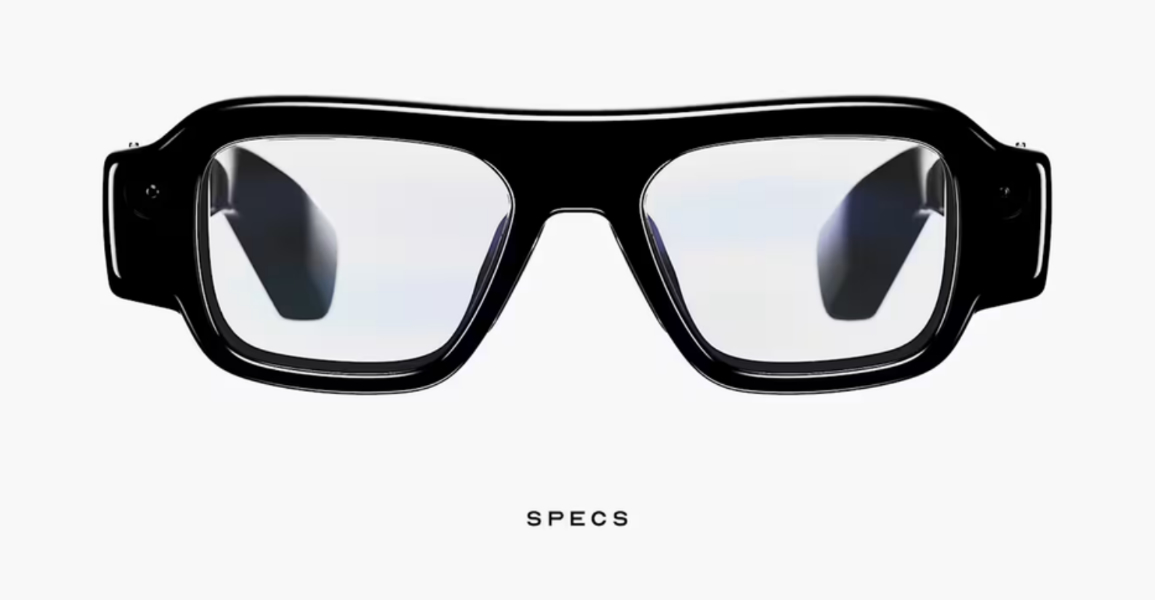
Snap, the company behind Snapchat, is preparing to ship Specs, its first augmented reality glasses aimed at the general public.
It is betting that consumers will pay a premium for see-through glasses that place digital content in their field of view.
The company unveiled Specs at the Augmented World Expo (AWE) in Long Beach, California, in June.
Pre-orders opened at $2,195 with a $200 refundable deposit, and shipping is expected this autumn in the US, UK and France.
Evan Spiegel, Snap’s co-founder and chief executive, said at the launch that Specs were “the beginning of a new era in computing”.
He argued that computers have long required people to look down at screens or step out of the moment, whereas the glasses bring computing into the world around them.
What Specs do
Specs are standalone: they do not need a separate processing unit or a cable to another device. They run on two Qualcomm Snapdragon chips, one for computer vision and one for AR experiences, which Snap calls “Lenses”.
The glasses have a 51-degree field of view, which Snap says gives a 30% larger display area than the previous generation. Their lenses tint automatically in about 10 seconds for outdoor use.
Battery life is up to four hours of mixed use, or around 20 hours in total with the charging case. The glasses come in two sizes, weighing 132g and 136g, which makes them about 40% lighter than the previous version. Prescription inserts are supported.
Snap is promoting AI as a central feature, saying the glasses can see what the wearer sees and offer help in context. On privacy, the company highlights on-device processing, permission prompts for sensitive information, and an LED light that shows when the glasses are recording.
Some key specifications have not been disclosed, including display resolution, brightness, storage and camera details.
Specs follow more than a decade of work on eyewear. Snap said last year that it had spent 11 years and more than $3bn developing the technology since its first Spectacles, a $130 camera-only product, launched in 2016.
Two further camera-only consumer versions followed in 2018 and 2019. Since 2021, Snap has released AR versions only to developers, including a fifth-generation model in 2024, to encourage apps to be built ahead of a consumer launch.
Meta’s expanding lineup
Specs will enter a market dominated by Meta. In the first quarter of 2026, Meta held 69.2% of global smart glasses shipments, according to the research firm IDC. RayNeo was second with 3.4% and Xiaomi third with 3.1%. Meta’s partner EssilorLuxottica, the eyewear group behind the Ray-Ban and Oakley brands, sold more than 7 million Meta AI glasses in 2025, more than triple the previous year.
Meta widened its range again at its annual Connect conference on 23 September. It announced the third-generation Ray-Ban Meta glasses, which have longer battery life and new frame styles, starting at $449. It also unveiled Ray-Ban Meta Audio, its first camera-free glasses, priced from $349 and shipping from 13 October.
Other announcements included an ultra-thin headset called Meta VR Glasses, priced at $1,299 for release next spring, and updates to its Meta Ray-Ban Display glasses.
Chief executive Mark Zuckerberg said Meta’s AI glasses would be available in more than 100 styles by the end of the year.
Most of Meta’s best-selling glasses are camera-and-audio devices built around a voice assistant, with no display. Snap’s Specs instead overlay graphics onto the real world through see-through lenses, a more technically demanding approach at a much higher price. Snap has described the market as a trade-off: AI glasses are easy to wear but limited, while headsets are powerful but cut users off from their surroundings.
A growing category
The smart glasses market has grown quickly. IDC recorded roughly 2.25 million units shipped in the first quarter of 2026, up 167% year on year, while eyewear with displays grew 86%. For display-less glasses alone, IDC forecasts $5.1bn in revenue this year and expects average prices, currently around $376, to fall to about $229 by 2030.
Competition is expected to intensify, with Google, Samsung and possibly Apple preparing products. Meta’s dominance has also drawn scrutiny: it faces pressure from civil society groups, regulators and US senators over its reported facial recognition plans.
Whether consumers will pay nearly five times the price of Meta’s flagship Ray-Bans for full augmented reality is likely to become clearer once Specs reach customers.