
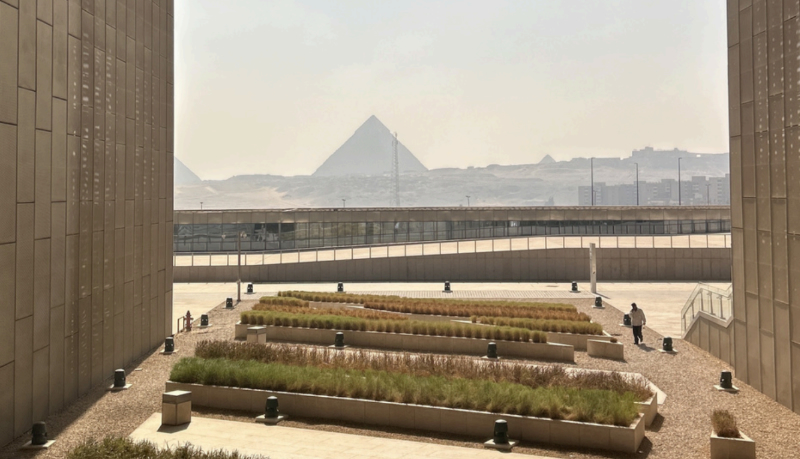
Egypt has unveiled its most ambitious cultural project to date: the Grand Egyptian Museum (GEM), located just a short distance from the iconic Giza Pyramid Complex outside Cairo. With this landmark institution, the country stakes a claim not just as custodian of ancient heritage, but as a 21st-century destination for global culture, tourism and innovation.
Origins & Vision
The idea for GEM was first floated in the early 1990s, as Egyptian authorities recognised that the old Egyptian Museum in Tahrir Square was no longer sufficient for the scale and ambition of the country’s antiquities. The official launch of the project came in 2002 (foundation stone) and full construction began in 2005. Delayed multiple times by economic, technical and regional challenges, GEM finally opened in full in late 2025.
The vision is bold: to create the world’s largest museum dedicated to a single civilisation (Ancient Egypt), housing tens of thousands of artefacts, integrating cutting-edge technology, and transforming the visitor experience while boosting tourism and national prestige.
Design & Build
The Museum was designed by the Dublin-based firm Heneghan Peng Architects, founded by Róisín Heneghan and Shih-Fu Peng. Their winning design from a 2003 international competition is celebrated for its monumental yet sensitive approach to the Giza Plateau.
GEM sits on a vast site near Giza — roughly 2 km from the Pyramids — and covers hundreds of thousands of square metres. The building comprises a striking triangular façade, glass, alabaster stone, and large transparent surfaces that allow views of the Pyramids. For example the north and south walls are aligned with the Great Pyramid of Khufu and the Pyramid of Menkaure, creating a strong visual link to ancient monuments. Construction was executed by a joint venture of Egyptian and international firms (including Orascom, BESIX) and required intense coordination to move large statues, fragile artefacts, and design a state-of-the-art conservation centre.
Exterior & Shape
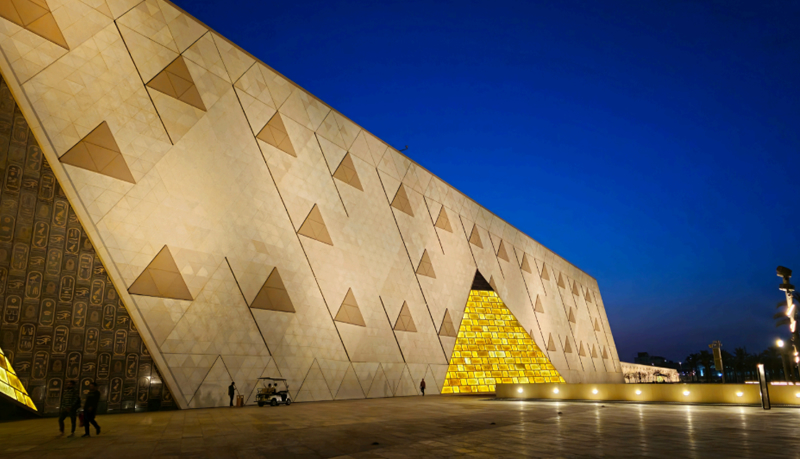
From the outside, GEM presents itself as both monumental and contemporary. The building’s angled geometry, alabaster-clad façade and expansive plaza of date palms give it a timeless yet fresh feel. Visitors approaching the museum are greeted by sweeping grounds, palm-lined vistas, and the Pyramids looming in the background — an immediate blending of past and present. According to press descriptions, the main atrium’s glass roof floods the entrance with light, and from within one can glimpse the Great Pyramid just beyond the building’s edge.
Interior & Galleries
Inside, the museum features twelve main permanent galleries, plus temporary exhibition halls, a large children’s museum, educational and conference facilities. One of the first spaces to grab attention is the Grand Hall (Atrium) — more than 10,000 m² in area — dominated by the colossal 11-metre, 83-ton statue of Ramesses II, moved here from Ramses Square in Cairo.
Among the most celebrated sections are the two halls dedicated exclusively to the treasures of Tutankhamun — over 5,000 artefacts from the young pharaoh’s tomb, displayed together for the first time.Ambient lighting, environmental controls for temperature and humidity, and immersive displays help present these objects in a way that honours their significance while offering a pristine visitor experience.
Technology & Visitor Experience
GEM isn’t just about ancient objects; it’s about delivering them through modern means. Multi-media installations, augmented reality, interactive screens, large-format video, and guided tours aim to engage younger generations and international travellers alike. The museum also houses one of the largest conservation and restoration complexes in the Middle East — laboratories and storage facilities designed to preserve artefacts for decades to come.
For visitors, the experience is designed for ease and engagement: clear pathways, multilingual signage, sweeping views of the Pyramids, spacious galleries, and accessible amenities. The setting near the Giza Plateau adds to the allure — you aren’t merely visiting the museum, you’re situating yourself almost within Egyptian antiquity.
Reception & Ambitions
The opening of GEM has been received with international acclaim. Egyptian stars who took the stage included actors such as the iconic Sherihan, Ahmed Malek, Ahmed al-Ghozzi, Salma Abou Deif, and Huda al-Mufti, alongside athletes Ahmed al-Gendy, Farida Osman, and Feryal Ashraf. The ceremony was overseen by Director and Director of Photography Maazen Elmotagawel who was also responsible for the same role in the Royal Mummies Parade celebration in 2021.
Prestigious media outlets refer to its scale, ambition and cultural importance. Politically and economically, the museum plays a key role in Egypt’s tourism strategy: it is expected to draw millions of visitors, help diversify the economy, and reposition Egypt as a global cultural destination.
The backers have stated ambitions which extend beyond artifact-display. They speak of GEM as a centre for archaeology, research and education; a venue for international conferences; a hub for archaeological labs and conservation science; and a cultural anchor for the region.
Why It Matters
For business travellers and culture-savvy visitors, GEM offers a compelling destination: it is easily accessible from Cairo, lies in proximity to other major heritage sites, and offers a level of presentation and ambition rarely found. Whether you’re planning a corporate event, an incentive trip, or combining meetings with high-end culture, the museum now stands as a world-class attraction.
It also sets a standard for how cultural heritage can be leveraged to stimulate tourism, education and international engagement. The marriage of ancient artifacts and modern architecture, immersive tech, and meticulous conservation means that you are not simply witnessing antiquity — you are participating in a story that spans millennia, told through a new lens.